
Amazon’s SP-API pricing changes in 2026 have raised questions among UK-based Amazon sellers and service providers, particularly those operating on Amazon.co.uk. Many assume nothing will change because Amazon does not bill sellers directly for SP-API usage.
In reality, most Amazon tools rely on SP-API behind the scenes. This raises an important question for sellers: which Amazon tools are affected by SP-API pricing changes, and how does that translate into real costs in 2026?
This article explains how free versus paid SP-API usage works in practice, which sellers are affected directly or indirectly, and what the real cost looks like for tools in 2026, without technical complexity.
Quick Summary
- Amazon SP API pricing in 2026 affects developers, but costs are passed to sellers
- Free tier refers to limited API usage, not free software tools
- Costs increase when tools make frequent or duplicate data requests
- High-usage setups with multiple tools are most likely to see price increases
- Efficient systems with fewer API calls help control long-term software costs
Who Is Directly Affected by SP-API Pricing Changes
Amazon’s SP-API pricing changes apply to third-party developers that build applications or services for other sellers. These are software providers, tool vendors, and agencies offering shared platforms or integrations across multiple accounts. Amazon charges these developers based on API access and usage.
In the UK, this typically includes software vendors, consultancies, agencies, and service providers managing Amazon seller accounts for multiple UK businesses.
Sellers who use SP-API only for their own business are not charged directly by Amazon. This includes businesses with custom internal integrations built solely for their own Amazon operations. These internal setups are not billed under the new SP-API pricing model.
In practice, however, most UK high-volume sellers rely on third-party tools rather than maintaining their own integrations. This is where SP-API costs are most likely to surface, as software providers adjust pricing or plans to account for their increased operating costs.
What “Free” Really Means Under SP-API Pricing in 2026
Under the Amazon SP-API pricing changes in 2026, “free” refers to API usage limits, not the price of seller tools. Amazon is expected to keep a Free Tier, which covers light usage. UK sellers with simple setups may see little or no immediate impact.
Free Tier usage usually includes:
- Basic order pulls
- Limited inventory updates
- Infrequent data checks
- Small catalogs with low automation
Important to know:
- Free Tier applies to API usage, not software pricing
- Third-party tools still decide their own prices
- Tool costs may change even if usage stays low
When Tools Shift From Free to Paid
Tools become paid when API usage increases, not because Amazon charges sellers directly. As the Amazon SP-API update for 2026 takes effect, this shift will mainly affect tools that rely on frequent data access.
Usage typically increases when tools:
- Sync prices or inventory frequently
- Run automation continuously
- Manage large catalogs
- Pull the same data across multiple tools
This is especially relevant for UK Amazon sellers and agencies using repricing, inventory syncing, or automation tools across multiple seller accounts.
As usage grows, developers move into paid tiers, which can lead to pricing or plan changes for sellers.
Paid SP-API Usage Explained Without Jargon
Paid SP-API usage depends on how often tools request data from Amazon.co.uk, not seller size or revenue. Every order check, inventory update, or dashboard refresh counts as usage.
What matters most:
- GET calls used to fetch data are metered
- High-frequency tools create more usage
- Inefficient tools cost more, even for small sellers
Common hidden usage comes from:
- Constant polling instead of notifications
- Duplicate tools pulling the same data
- Live dashboards refreshing automatically
Under the new model, tool efficiency matters more than features. Better-built tools are more likely to keep costs stable as Amazon SP-API fees roll out.
Free vs Paid Tools – Real-World Usage Scenarios
| Setup Type | Typical Tool Stack | SP-API Usage Level | Likely 2026 Cost Impact |
|---|---|---|---|
| Low-Usage | Basic order and inventory tools with scheduled updates | Low | Usually remains within the Free Tier. Little or no immediate pricing impact. |
| Medium-Usage | Inventory sync, repricing tools, and daily reporting dashboards | Moderate | Tools may move into a paid base tier, but most usage is typically covered once that threshold is reached. |
| High-Usage | Multiple tools, near real-time repricing, and live dashboards used by UK sellers or agencies managing Amazon.co.uk accounts | High | Higher likelihood of pricing increases as usage scales beyond base tier allowances across multiple tools. |
Important Clarification for 2026
While some medium-usage tools may move out of the Free Tier, the next pricing tier covers a significantly higher usage allowance for UK sellers. This means many “medium” tools are likely to remain stable once the base tier is reached. The largest pricing pressure is expected where multiple high-frequency tools operate together, not from moderate usage alone.
- Key takeaway: SP-API costs do not increase because of one tool moving tiers. They increase when multiple tools create overlapping, high-frequency usage across the same Amazon data.
Hidden Costs Sellers Often Overlook
Many UK sellers assume SP-API costs only increase when they add new tools. In reality, hidden usage often comes from existing setups that quietly generate API activity in the background.
1. Duplicate Data Pulls
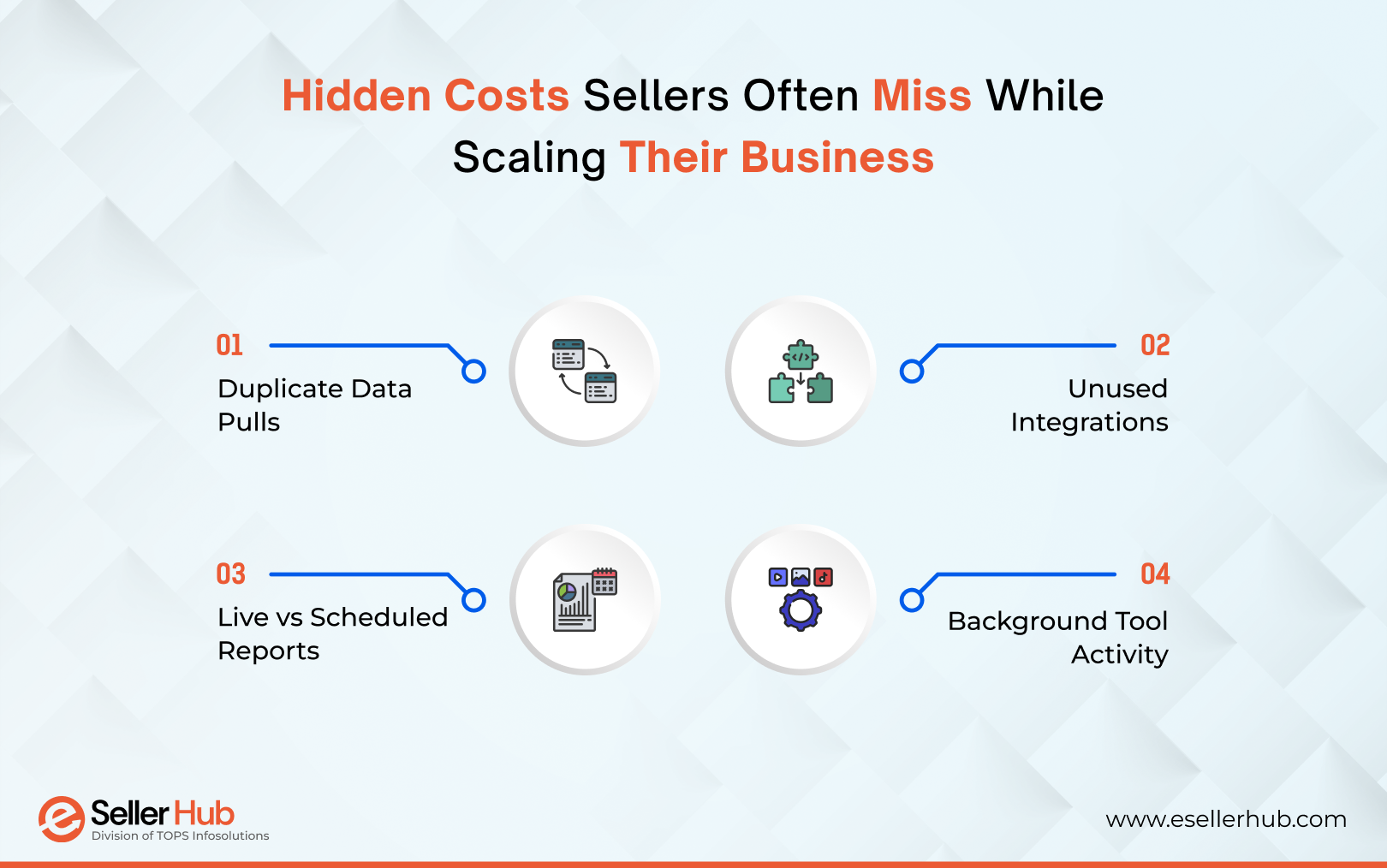
It is common for sellers to use separate tools for repricing, inventory management, order management, and analytics. When each tool pulls the same order or inventory data independently, SP-API usage stacks quickly. This duplication is a major driver of rising Amazon SP-API tool costs.
2. Unused or Legacy Integrations
UK agency-managed accounts and long-running seller setups often include old connectors that were never removed. Even if a tool is no longer actively used, its integration may still be authorised and running background processes, increasing usage under the Amazon SP-API pricing changes.
3. Live vs Scheduled Reporting
Live dashboards refresh data constantly, even when no one is actively reviewing them. Scheduled reports retrieve the same information at fixed intervals using far fewer requests. The difference is rarely visible to sellers but has a real impact on SP-API usage for UK Amazon accounts..
4. Background Activity From Unused Tools
Free trials, test tools, or temporary integrations often remain connected long after they are needed. These background processes continue making requests, quietly pushing tools closer to paid usage tiers under the Amazon SP-API update in 2026 for UK sellers.
Who Benefits From Free vs Paid Models
SP-API pricing in 2026 affects UK sellers and service providers differently based on how their tools are used, not business size.
More likely to remain within Free Tier usage:
- Simple setups with limited automation
- Scheduled updates instead of real-time syncing
- One or two core tools connected to Amazon
More likely to move into paid usage:
- Frequent repricing or inventory syncing
- Multiple tools pulling the same data
- UK agency-managed or tool-heavy setups
The key difference is usage patterns, not revenue, for UK sellers. Sellers with efficient systems often generate less SP-API activity than smaller sellers using high-frequency automation.
How Sellers Can Control SP-API-Driven Costs
While sellers cannot control Amazon’s pricing model, they can control how efficiently their tools use SP-API.
Practical steps to reduce unnecessary usage:
The first step is understanding how to check Amazon SP-API usage so you can see which connected tools are actively generating API calls.
- Audit connected tools: Review which applications are currently authorised to access your Amazon account
- Remove unused or overlapping tools: Disconnect tools that duplicate functionality or are no longer part of your workflow
- Ask vendors about usage efficiency: Simple questions about how often data is pulled can reveal potential cost exposure
- Prefer efficient syncing: Tools that use scheduled updates or event-based syncing typically generate less usage than constant polling
Much of this efficiency depends on how well your Amazon SP API integration is structured across your systems. Even small adjustments can reduce hidden usage and help keep software costs stable as SP-API pricing changes roll out in 2026.
How eSellerHub Supports Cost-Efficient SP-API Usage
eSellerHub helps UK sellers, 3PLs, and service providers simplify how their systems interact with Amazon as SP-API pricing changes take effect. Instead of relying on multiple disconnected tools, we design custom backend workflows that centralise data handling and reduce unnecessary API usage.
By streamlining integrations and removing duplicated data requests, sellers gain more predictable performance and better control over long-term operating costs. This approach supports scaling without increasing SP-API activity simply due to inefficient tool setups.
Conclusion
Amazon’s SP-API pricing changes in 2026 are not about introducing new tools or forcing sellers to change platforms. They reflect a shift in how data usage is measured and priced behind the scenes.
For sellers, the real impact depends on how efficiently their tools interact with Amazon. Those who understand the difference between free API access and tool-level costs are better positioned to avoid surprises. Reviewing existing setups, reducing overlap, and choosing efficient integrations can help keep software costs predictable as SP-API pricing evolves.
Preparing early is not about reacting to fees. It is about understanding where usage comes from and making informed decisions before pricing changes take full effect.
Frequently Asked Questions
1. Does Amazon charge sellers directly for SP API usage in 2026?
No. Amazon charges third-party developers, not sellers directly. However, most software providers pass these costs on through higher subscription fees for UK Amazon sellers.
2. What does the free tier mean in Amazon SP API pricing?
The free tier refers to limited API usage, such as basic order updates and low-frequency data requests. It does not mean that third-party tools or software will remain free.
3. Which Amazon tools are affected by SP API pricing changes?
Tools that rely on frequent data access, such as repricing software, inventory sync systems, analytics dashboards, and automation tools, are most affected by SP API pricing changes.
4. When do tools move from free to paid usage?
Tools move into paid usage when API activity increases beyond free limits. This usually happens with frequent syncing, large product catalogues, or multiple tools accessing the same data.
5. What increases SP API costs for UK Amazon sellers?
Costs increase when tools make repeated or duplicate GET requests, use constant polling instead of notifications, or when multiple tools pull the same data from Amazon.
6. Can small or low-volume sellers stay within the free tier?
Yes. Sellers with simple setups, limited automation, and fewer tools are more likely to remain within free usage limits, provided their API activity stays low.
7. How can sellers reduce SP API-related software costs?
Sellers can reduce costs by auditing connected tools, removing unused integrations, avoiding duplicate data pulls, and choosing systems that use efficient syncing methods such as scheduled updates or event-based notifications.



 34173 Gannon Terrace,