

Most UK Amazon sellers aren’t short on data; they’re short on clarity.
This is a common Amazon data-visibility challenge, where UK businesses struggle to get a unified view across systems.
Sales reports are there. Inventory is being tracked. Orders are coming in daily. Yet when it comes to understanding why the numbers look the way they do, things quickly stop adding up.
For brands scaling across Amazon, Shopify, and D2C channels, data is often spread across multiple systems. It is a classic case of e-commerce data fragmentation that limits visibility. Each platform holds its own version of information, making it difficult to get a reliable, unified view of the business.
Figures don’t quite match across platforms, and inventory levels are unreliable. And decisions get delayed while teams try to reconcile conflicting data, which often impacts operations in the process.
In this blog, we’ll show why e-commerce data visibility breaks across systems, where the gaps really are, and what better cross-channel reporting looks like, so you can stop second-guessing your numbers and start making faster, more confident decisions.
Quick Summary
Most Amazon sellers don’t struggle because they lack data. The problem is that their data is spread across systems and doesn’t provide a clear, unified view.
- Data is stored across multiple systems, so there is no single place to see accurate business performance.
- Platforms like Amazon and Shopify do not sync directly, which leads to data mismatch across channels, a common issue in UK ecommerce operations.
- Inventory updates are not always reflected in real time, causing inventory sync issues and incorrect stock visibility, especially in UK ecommerce environments.
- Teams rely on manual reporting to combine data, which slows down decision-making and creates errors.
- As the number of SKUs increases, it becomes harder to track product-level performance and maintain a clear, unified e-commerce data visibility.
Why Most Sellers Think Everything Is Fine
At first, everything appears to be working as expected.
Sales reports are available, dashboards show consistent numbers, and orders are being processed without major issues. For many sellers, this creates a sense that their data is accurate and their operations are under control.
However, this confidence is often based on surface-level visibility rather than true e-commerce data visibility.
The problem usually becomes clear only when something goes wrong.
- A product shows as in stock, but orders cannot be fulfilled
- Sales numbers differ between systems, a typical sign of Amazon UK reporting problems caused by disconnected systems.
- Fulfilment delays increase without a clear reason
These situations are not isolated issues. They are early signs of data mismatch across channels and underlying e-commerce data fragmentation.
At a smaller scale, these gaps are easy to ignore. But as the business grows, they become more frequent and harder to manage. What once seemed manageable starts affecting daily operations and decision-making.
Where Data Visibility Breaks Across Channels
Data does not disappear. It gets split across systems and becomes harder to connect, especially when there is no structured multichannel ecommerce solution connecting them. For multichannel sellers, these gaps usually appear in a few key areas where systems operate independently.
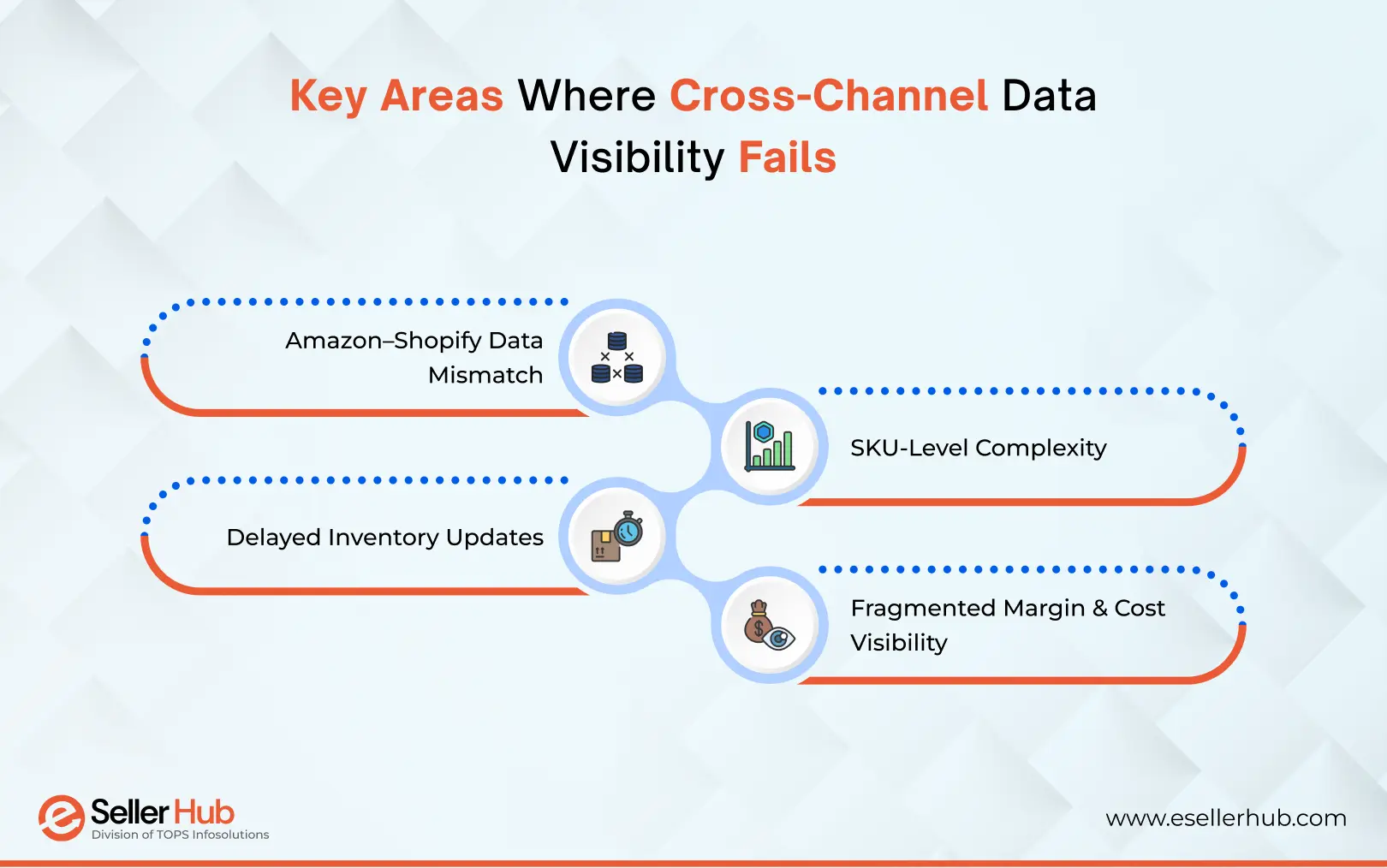
1. Amazon and Shopify Data Mismatch
Amazon and Shopify are built differently and manage data separately. There is no native connection that keeps both systems aligned, unless supported by something like Amazon SP-API integration.
As a result, you often end up with two different versions of the same data, leading to an Amazon Shopify data mismatch.
The result: If a return is processed on Amazon, it may not reflect in Shopify reports. If pricing or promotions change on one channel, the other remains unchanged. Without a unified view, total revenue and performance data become unreliable, which directly impacts overall Amazon data visibility.
2. Inventory Updates Come Too Late
In most setups, inventory updates are not instant across all systems. Instead, they are updated with a delay. Especially when inventory management software is not fully integrated across channels.
This creates inventory sync issues, especially when order volume is high.
The risk: If limited stock is sold on one channel, other channels may still show it as available. This leads to overselling, order cancellations, and a negative impact on customer experience and seller performance.
3. SKU-Level Complexity
Managing a small catalogue is straightforward. But as the number of products and variations increases, tracking performance becomes more complex.
Variations such as size, colour, or bundles make it harder to get clear product-level insights.
The confusion: A product may appear profitable overall, but certain variations may be underperforming. Without detailed SKU-level visibility, decisions are made based on averages rather than accurate data, reducing overall e-commerce data visibility.
4. Margin and Cost Visibility Is Fragmented
Data related to fees, returns, and costs is often stored in separate systems.
Amazon fees, product costs, and advertising spend are tracked independently, which makes it difficult to calculate real-time profitability.
The gap: When these values are not connected, sellers cannot see accurate margins. Instead, they rely on delayed reports, limiting e-commerce data visibility that UK businesses rely on for accurate decisions.
The Hidden Problem: Manual Reporting
While system gaps are the root cause, the way most teams try to manage them creates another issue: reliance on manual reporting.
In the absence of reliable multichannel ecommerce software, when platforms do not connect directly, the team becomes the link between systems. This is where multichannel reporting problems begin.
This leads to several challenges:
- Time-consuming work: Teams spend hours exporting data from Amazon and Shopify, then combining it in spreadsheets. This time could be used for operations and growth instead of manual data handling.
- Human error: A small mistake in formulas or data mapping can lead to incorrect reporting, affecting decisions and planning.
- Not scalable: Manual reconciliation may work at a smaller scale, but as order volume increases, it becomes difficult to manage. This leads to delays, errors, and reduced e-commerce data visibility.
Why Visibility Gets Worse as You Scale
Growth is the goal for every e-commerce business. But when data is fragmented, growth also increases operational risk. As the business expands, complexity increases across systems. This is where e-commerce data fragmentation starts to have a direct impact on daily operations.
- More SKUs: Adding more products and variations increases the number of data points that need to be tracked and managed across systems.
- More Channels: Expanding to platforms like eBay, TikTok Shop, or additional marketplaces adds new systems that do not sync automatically.
- Higher Order Volume: As sales increase, even small delays in updates become more critical. Inventory sync delays that were manageable earlier now create serious issues.
The Result: As scale increases, data becomes harder to manage and slower to act on. Instead of improving operations, growth starts to expose gaps in data visibility across channels, making decision-making more reactive than proactive.
The Real Business Impact
When data is fragmented, the impact is not limited to reporting. It directly affects daily operations, customer experience, and revenue.
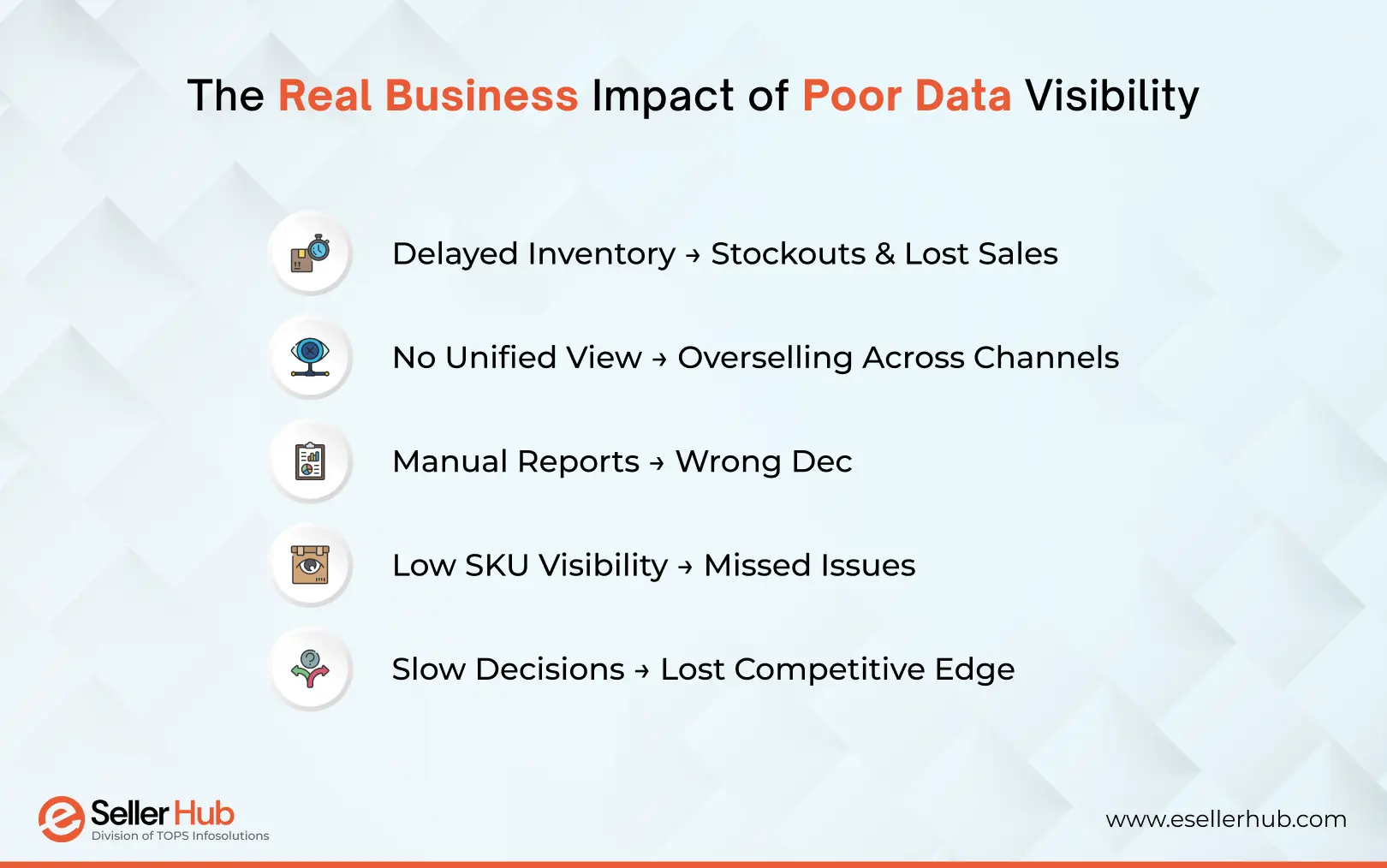
Delayed inventory updates → Stockouts and lost sales
When inventory data is not updated in time, products go out of stock without warning, leading to missed sales opportunities.
No unified view → Overselling across channels
Without a clear view of inventory across platforms, the same stock can be sold multiple times, creating fulfilment issues.
Manual reporting delays → Wrong decisions
Decisions based on outdated or incomplete data often lead to incorrect restocking and planning.
Limited SKU visibility → Missed performance issues
Without detailed insights, underperforming products or variations are not identified early.
Slow decision-making → Reduced competitiveness
Businesses that cannot act quickly fall behind competitors who operate with better e-commerce data visibility.
These issues are not isolated. They are connected outcomes of poor data visibility across channels, and they become more frequent as the business scales.
What Good Data Visibility Actually Looks Like
To address these challenges, businesses need to move away from fragmented reports and work towards a single, reliable view of their data. Good data visibility is not just about having a dashboard. It is about having a system where data flows accurately across all channels.
In practice, strong data visibility across channels is defined by a few key elements:
- Unified data view: Data from platforms like Amazon, Shopify, as well as warehouse management systems data is combined into one clear and consistent view, eliminating the need to switch between systems.
- Real-time synchronization: Inventory and order data are updated across all systems with minimal delay with an order management system. When a product is sold on one channel, stock levels are reflected across others, reducing inventory sync issues.
- SKU-level clarity: Businesses can track performance at the product and variation level, making it easier to identify which items are performing well and which require attention.
- Proactive alerts: Instead of identifying issues after they occur, systems provide early signals based on trends such as sales velocity or stock levels, allowing teams to act in advance.
Example: Before vs After Visibility
The difference between fragmented data and clear visibility becomes easier to understand when compared side by side.
| Before: Fragmented Visibility | After: Unified Data Visibility |
|---|---|
| Data is spread across platforms like Amazon, Shopify, and warehouse systems | A single view combines orders, inventory, and performance across all channels |
| Reports show different numbers across systems | Data is updated in real time or near real time |
| Inventory levels are inconsistent across channels | Inventory remains aligned across all platforms |
| Issues such as stockouts or delays are identified late | Issues are identified early through alerts |
| Teams rely on manual data reconciliation | Decisions are made quickly using accurate data |
| Limited visibility into performance across systems | Clear data visibility across channels supports better decisions |
How eSellerHub Helps
Improving data visibility across channels requires more than separate tools. It needs a system where data flows consistently across platforms.
eSellerHub connects platforms like Amazon, Shopify, and warehouse systems into a single backend, giving businesses a unified view of operations.
- Unified data view: Orders, inventory, and performance data are available in one place.
- Real-time updates: Changes are reflected across channels with minimal delay, reducing inventory sync issues.
- Centralized operations: Manage workflows through an integrated order management system and inventory management software.
- Warehouse integration: Sync data with warehouse management systems for accurate fulfilment.
- Custom dashboards: Clear insights supported by e-commerce dashboard development services for clearer reporting
This helps reduce manual work and gives businesses a more reliable and scalable way to manage operations.
Conclusion
In multichannel selling, data is only useful when you can see it clearly. When data is fragmented across Amazon, Shopify, and warehouse systems, it becomes harder to make reliable decisions.
Relying on manual spreadsheets and disconnected tools leads to issues like stockouts, overselling, and delayed insights. To scale effectively, businesses need a single, connected view of their data.
With better data visibility across channels, teams can move from reactive decisions to more consistent and controlled operations.

Frequently Asked Questions
1. What is data visibility in e-commerce?
Data visibility in e-commerce means having a clear and unified view of orders, inventory, and performance across all systems. It allows businesses to understand what is happening in real time and make accurate decisions without relying on multiple reports.
2. Why does Amazon data not match inventory?
Amazon data may not match inventory because systems like Amazon, Shopify, and warehouse platforms do not sync automatically. Delays in updates and disconnected systems often cause data mismatch across channels and inventory sync issues.
3. Why do Amazon and Shopify data not match?
Amazon and Shopify operate as separate systems with different data structures. Without proper integration, orders, inventory, and returns are recorded differently, which leads to inconsistent reporting and data mismatch across channels.
4. What causes inventory sync issues in UK e-commerce?
Inventory sync issues are usually caused by delayed updates between systems, lack of real-time synchronization, and disconnected platforms. When one system updates stock, but others do not reflect it immediately, it creates inaccurate inventory levels.
5. How can I fix data visibility issues across channels?
To fix data visibility issues, businesses need to connect all systems into a unified setup where data flows automatically. This reduces manual reporting, improves accuracy, and provides a single view of operations across channels.
6. What is a single source of truth in e-commerce?
A single source of truth is a system where all business data is consolidated into one place. It ensures that orders, inventory, and performance data are consistent across platforms, improving decision-making and reducing errors.
7. How do UK Amazon sellers' data issues affect e-commerce growth?
Poor data visibility leads to stockouts, overselling, delayed decisions, and inaccurate reporting. Over time, these issues impact customer experience, reduce operational efficiency, and limit business growth.
8. Is real-time data important for e-commerce operations?
Yes, real-time or near-real-time data is important because it allows businesses to respond quickly to changes in inventory, orders, and demand. Without it, decisions are based on outdated information, increasing the risk of errors.



 34173 Gannon Terrace,